Our Focus
Science, technology, engineering and mathematics (STEM) education emphasizes critical thinking, problem-solving and collaboration to prepare students for the complexities of the modern world. STEM education equips learners with essential skills for an increasingly technology-driven economy.
Programming is rapidly becoming a foundational skill that has value across disciplines. When you consider that computer programs are now used to analyze great works of art and literature to identify patterns, cross-connections and authenticity, one thing becomes clear: in nearly every field, those who understand how to program computers have a profound advantage over those who don’t.
Computer science is a powerful way to teach kids problem solving and critical thinking skills. Math, science, and computer science are the three pillars of modern problem solving in this generation. In math, we learn how to describe the world using numbers. In science, we learn how to build predictive, testable theories. In computer science, we learn how to translate mathematical models and scientific theories into executable simulation programs. Through programming, students learn how to describe the solution to a single problem as a precise, repeatable process that can scale to solve millions of similar problems.
Careers in computer science related are abundant and lucrative. All kids deserve to have some exposure to CS so they can discover whether it is something they might want to do professionally. Computer science is far more than “just a trade skill,” but to the extent that programming is a trade skill, it is a particularly important one to our economy.
Through the Universal Advance Academy (UAACA) Code4Life program, our students will have the opportunity to experience firsthand the revolutionary world brought about by artificial intelligence and robotics. Let’s begin!

Why learn and invest in yourself?
Child learning often relies on exploration, play, and guided instruction to build foundational skills, with a strong dependence on external motivation. In contrast, adult learning is typically self-directed, goal-oriented, and driven by internal motivation and prior experiences.
Lifelong learning and investment in the next generation are foundational drivers of personal, professional, and economic growth. In a rapidly changing world, this approach ensures individuals remain adaptable and productive, while fostering innovation and sustainability.
Lifelong Learning as a Driver of Growth
- Continuous Adaptation: In the era of AI and rapid technological shifts, learning is no longer a one-time event but a necessity for staying relevant.
- Cognitive: Engaging in continuous education keeps the brain active, supports mental well-being, and boosts confidence and resilience.
- Economic Impact: Lifelong learning improves employ ability, allows for career mobility, and increases earning potential.
Investing in the Next Generation
- Foundation for Future Success: K-12 education is critical for developing the cognitive, critical thinking, and problem-solving skills necessary for future success.
- High Economic Returns: Investing in education for children and youth yields significant economic and social returns, with some studies showing a tenfold return on investment for youth programs.
- Inter-generational Benefits: Educated parents and communities create better, more stable environments, leading to improved health and economic outcomes for future generation.
Key Strategies for Growth
- Flexible Education: Accessible, low-barrier learning options (such as micro-credentials) are crucial for balancing earning and learning.
- Cultivating a Growth Mindset: Encouraging curiosity and resilience helps individuals see challenges as opportunities, stimulating long-term personal and professional development.
By prioritizing education as a continuous process, communities can ensure they have the skilled, agile workforce needed to thrive in an evolving global landscape.
About Code4LiFE Computer Training
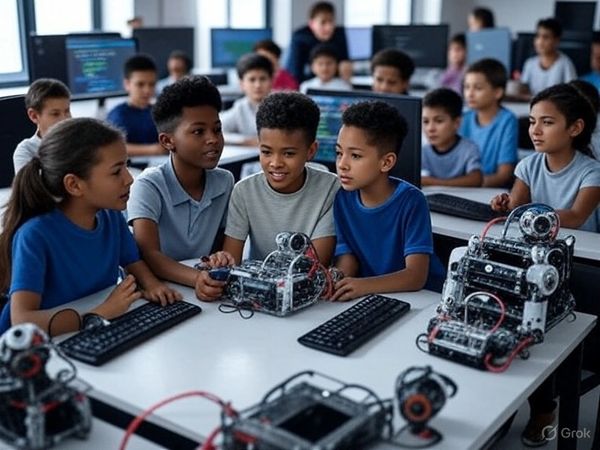
About the courses
Understanding the character of our courses or “Code for LIFE” program is crucial for students to make informed decisions about their educational path and to ensure they choose options that align with their interests and goals. These are the most important elements, we would like to focus.
- Individualized attention for every child. We keep class sizes small, to ensure your child receives personalized support, guidance, and encouragement at every step of their coding journey.
- Multiple teachers, including teaching assistants and tech leaders, cover a variety of subjects and/or assignments. Carefully designed year-round program supported by innovate teaching methodology and bringing innovative approach to life.

About Us
At Universal Advance Academy, our program emphasizes problem-solving, creativity, and critical thinking, fostering STEM skills in an innovative and inspiring environment. While learn on fundamental principles, the courses keep children interested and excited about coding through web development, games, and robotics labs excises. We are committed to providing children with an exceptional coding education, leveraging cutting-edge technology and tools to make learning fun and effective.
Modern education emphasizes flexibility, speed, and applied
K-12 STEM Education and Artificial Intelligence & Systems Engineering
While Artificial Intelligence (AI) & Systems Engineering isn’t replacing Computer Science (CS) as a whole, it represents a major, evolving specialization within or closely linked to Computer Science, focusing on building, deploying, and managing complex intelligent systems, merging software, hardware, and AI techniques for real-world applications like robotics and autonomous vehicles, differing from core CS by its emphasis on practical, integrated, and ethical system design.
We focus on K-12 STEM education and artificial intelligence and systems engineering, offering courses to help address the lack of public education opportunities due to a lack of skills or teaching resource here in BC.
We offer a diverse range of courses for students of all ages, covering everything from STEM concepts to hands-on lab workshops, from block coding to Python, and more advanced topics like Java (C#, or C++). For example, the typical transition from Grades 5-12 STEM courses to AP Programming involves first learning Python foundations (Grades 5-8), then AP Computer Science Principles (CSP), using Python or graphical programming (Grades 9-10) to grasp broad concepts, and finally AP Computer Science A (CSA), using Java (Grades 10-12) to delve deeper into object-oriented programming, preparing for AP exams and college applications. At UAA, we offer Python courses for lower-grade students, combining AP CSP with Python, while AP CSA focuses on Java; all these courses are designed to develop students’ computational thinking skills and lay the foundation for advanced learning.
